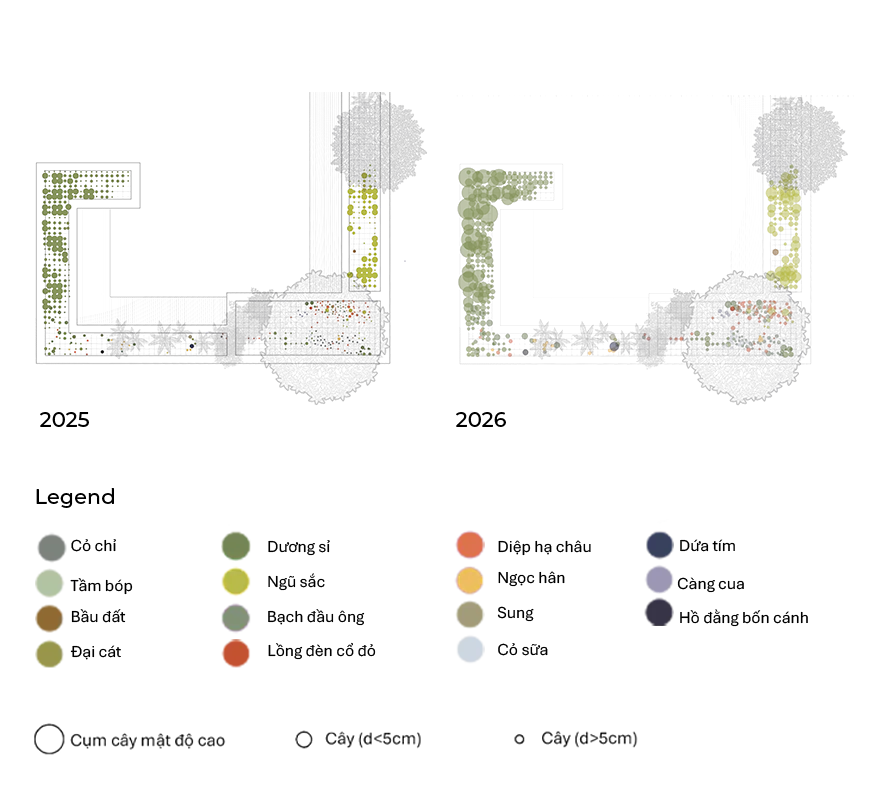
The Glocal Design is one of the key pillars of the smART Hub Living Labs (SHLL), focusing on developing adaptive infrastructure and sustainable landscape solutions at Campus V.
1. Core Objectives and Philosophy- Glocal Harmony: The goal of WP2 is to harmonize international urban design standards with indigenous knowledge. Rather than mechanically applying foreign standards, the project adapts them to suit the tropical climate and local cultural context.
- Research-by-Design (RBD) Methodology: Instead of relying purely on intuition, every physical intervention at Campus V is treated as an active experiment. The outcomes are documented as scientific research data, not just aesthetic solutions.
2. Key Interventions- SHLL is used as a "sandbox" to implement adaptive models:
- Sod Culture: Focuses on preserving and developing native plant species.
- Grounding Gardens (Healing Gardens): Designs barefoot walking paths to strengthen the connection between people and nature.
- Bioswales: This system manages stormwater and wastewater through ecological methods, helping reduce flooding—one of the long-standing bottlenecks of Campus V.
- All interventions in WP2 follow the "Test - Measure - Learn" cycle: Technical Audit: Structures such as bioswales and planting systems are subject to regular audit protocols. For example, the team evaluates drainage performance after storms and the survival rate of plants under harsh weather conditions.
- Fail-Log Documentation: Technical errors or mechanical failures during operation are recorded in a "Fail-Log" to capture lessons learned for future projects.
4. Continuity and Scaling Strategy- Knowledge Governance: Chief Architect Dang The Hien oversees coordination to ensure continuity despite personnel changes, with the goal of completing all technical drawings by July 2026.
- Regional Integration: WP2 incorporates findings from the AUD2026 project in Hue and applies them to the high-density urban context of Ho Chi Minh City.
- Three-Tier Scaling Strategy:
Deepening: Refining solutions directly at Campus V.
Broadening: Applying results to other contexts such as Hue.
Scaling Up: Transforming experimental data into urban policy recommendations.
Personnel: After the previous architects departed, Chief Architect Dang The Hien directly coordinated this work package to ensure completion of the technical drawings by July 2026.
By the end of 2026, the Glocal Design package is expected to deliver:
Technical Playbook: A technical handbook on Glocal Design and adaptive landscape experimentation.
Visual Storytelling: Diagrams that narrate the community-based spatial intervention process.
In summary, Glocal Design is not merely a landscape improvement effort but a structured research strategy aimed at developing sustainable architectural solutions that directly contribute to the Net Zero Campus 2026 goal.