
ISCM ACCOMPANIES LOCAL LEADERS IN STRATEGIC PLANNING TO ENHANCE THE COMPETITIVENESS OF CA MAU’S TOURISM CLUSTER


On September 18, 2025, as part of a leadership, administration, and management capacity-building program for commune-level officials in Ca Mau Province, Assoc. Prof. Dr. Trinh Tu Anh, Director of the Institute of Smart City and Management (ISCM), and Dr. Pham Nguyen Hoai, Director of the Bachelor of Smart Mobility and Operation Management (BMOM) program, delivered lectures in the training course entitled “Strategic Planning to Enhance the Competitiveness of Ca Mau Province’s Tourism Cluster.”
The course was designed for strategic-level leaders and managers of commune-level governments, including Party Secretaries, Chairpersons, and Vice Chairpersons of commune-level People’s Committees. Its focus went beyond identifying local tourism potential to updating participants on changing approaches to tourism development amid the emergence of new economic models, digital transformation, smart cities, and the Fourth Industrial Revolution.
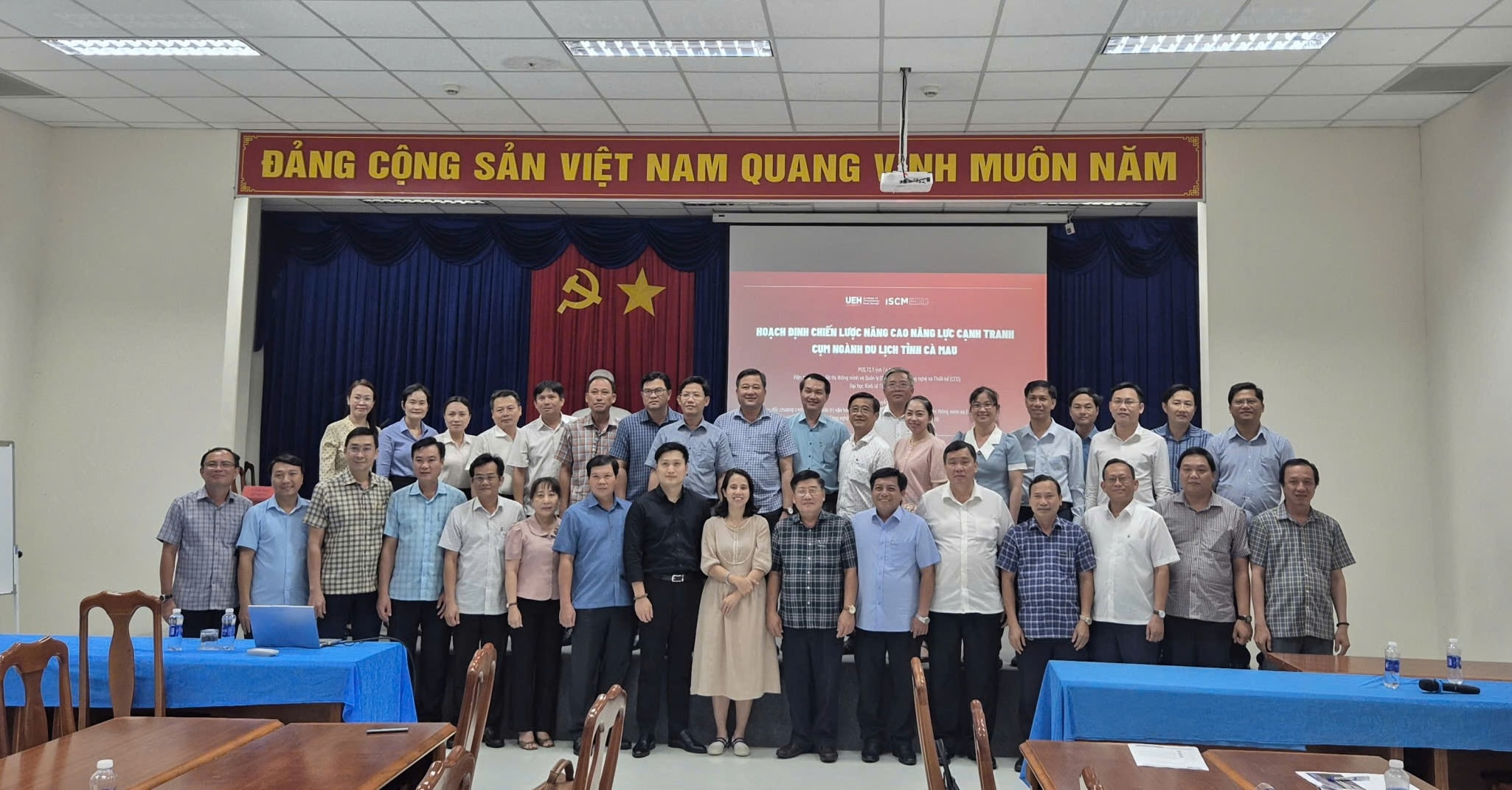
ISCM lecturers pose for a commemorative photo with the training participants.
When new economic models transform the way tourism operates
At the beginning of the course, Assoc. Prof. Dr. Trinh Tu Anh and Dr. Pham Nguyen Hoai worked with participants to examine ongoing shifts in the economy and their impacts on the tourism sector. Models such as the digital economy, night-time economy, informal economy, circular economy, and low-altitude economy are changing how tourists search for information, choose destinations, use services, and experience a locality. At the same time, these shifts are creating new ways for businesses, communities, and government to participate together in the tourism value chain.
Building on these changes, the class discussed weaknesses in conventional approaches to tourism development, particularly where tourism remains heavily dependent on exploiting natural resources and existing attractions; products lack differentiation; services and stakeholders operate in isolation; data are not effectively utilized; visitor experience is not placed at the center; and local community participation in value creation remains limited. These issues framed a central question throughout the course: In a rapidly changing economy, what should localities do to move from merely exploiting tourism potential toward building long-term competitiveness?
From traditional tourism to smart and sustainable tourism
From the limitations of the traditional model, the course expanded the discussion to smart, green, and sustainable tourism in the context of smart city development and the Fourth Industrial Revolution. Through classroom exchanges, participants explored the view that technology is not the ultimate goal of smart tourism. Data, digital platforms, artificial intelligence, the Internet of Things, and other emerging technologies should instead be seen as tools that help localities better understand visitors, connect stakeholders across the ecosystem, enhance experiences, improve destination management, and support decision-making. Alongside technology, the course emphasized that tourism development should be linked to resource conservation, destination branding, and the creation of socio-economic value for local communities. Accordingly, “smart” and “sustainable” should not be treated as separate development pathways, but integrated within a strategy to strengthen destination competitiveness.
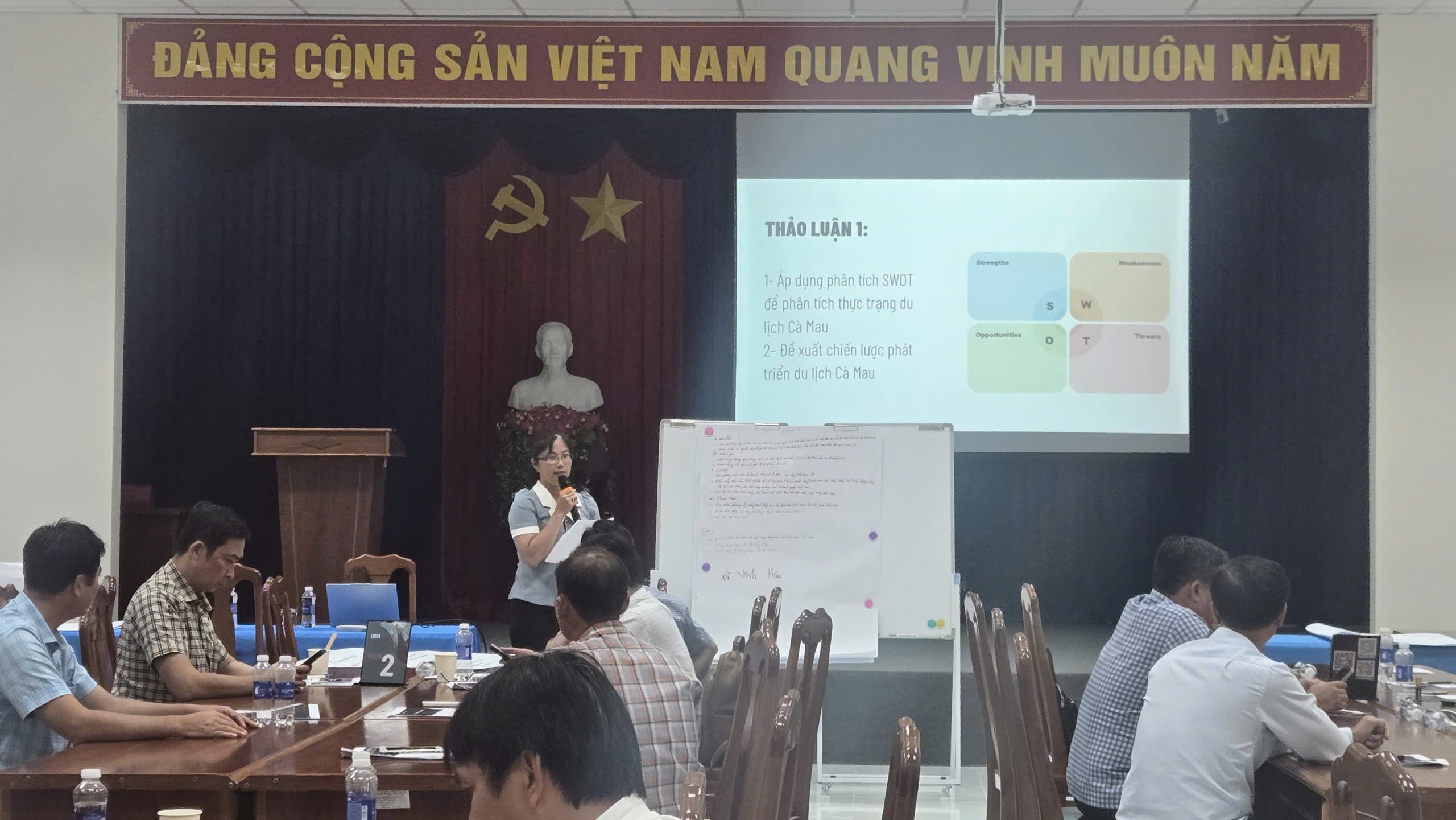
Participants present their views during a discussion session in the training course.
Living Lab – from ideas to experimentation within the locality
One of the topics discussed in the course was the Living Lab approach, introduced as a way to bring innovation into the real-life context of a locality. Rather than relying on a traditional solution-development process, the Living Lab and co-creation model was proposed as a means of building a collaborative innovation ecosystem in which government, businesses, residents, tourists, universities/research institutes, and other stakeholders jointly identify problems, co-create solutions, test them in practice, evaluate the results, and continue to refine them. From this perspective, the class discussed the possibility of treating destinations and communities in Ca Mau themselves as experimentation spaces for new initiatives, ranging from tourism experience design, technology and data applications, and local storytelling to identity-based product development, community-based tourism, circular economy solutions, and environmental protection. In this way, the Living Lab was introduced not merely as a concept but as a practical approach to strategy implementation through experimentation, learning, adjustment, and scaling—particularly suitable for localities seeking to promote innovation while starting from concrete challenges and available resources.
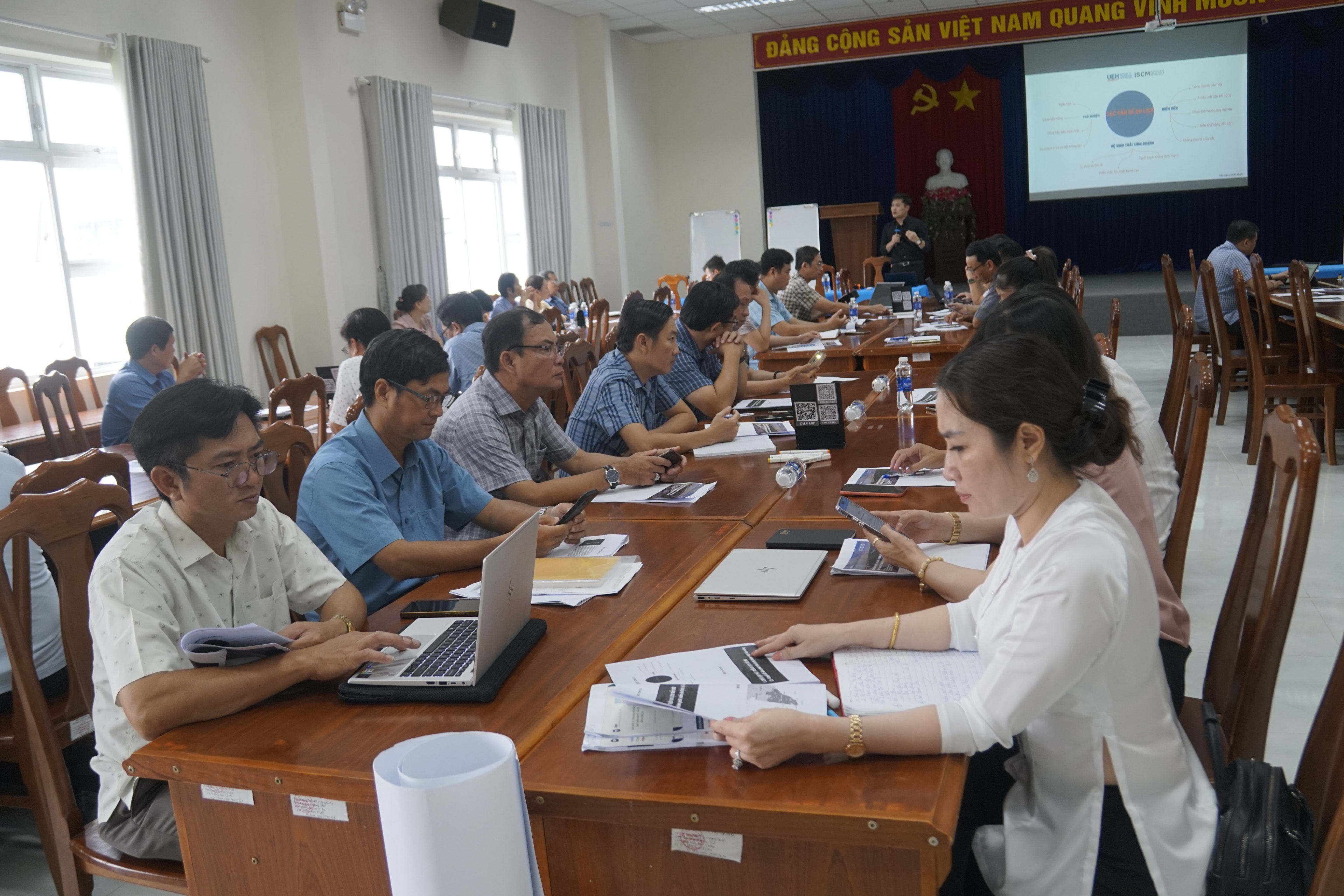
Overview of the training course “Strategic Planning to Enhance the Competitiveness of Ca Mau Province’s Tourism Cluster.”
From new economic models to smart tourism, and from sustainable development to Living Labs, the course delivered by Assoc. Prof. Dr. Trinh Tu Anh and Dr. Pham Nguyen Hoai aimed to foster an important shift in thinking: rather than merely exploiting what a locality already has, local stakeholders should proactively connect resources, experiment with new approaches, and co-create new value for the destination together with the community, thereby strengthening the competitiveness of Ca Mau Province’s tourism cluster.
News and photos by Dr. Pham Nguyen Hoai