
UBU 2026 kicks off at Van Thang Agarwood Village: international students join the community to "co-create place identity"


On the morning of 21 July, the international summer camp for sustainable development "Urban Beyond the Urban" (UBU) 2026, themed "Co-creating Place Identity: From Indigenous Heritage to a Sustainable Future", officially opened in Van Thang commune, Khanh Hoa province.
UBU 2026 runs from 20 to 25 July 2026 and is organised by the Institute of Smart City and Management (ISCM), College of Technology and Design, University of Economics Ho Chi Minh City (UEH), and co-chaired by Handong Global University (Korea) and the University of Trieste (Italy). The programme brings together students from the University of Economics Ho Chi Minh City (UEH), Handong Global University (Korea), the National University of Singapore (NUS), Hanoi Architectural University and Ho Chi Minh City University of Technology and Education, under the guidance of lecturers from the Institute of Smart City and Management (ISCM) – UEH, Handong Global University (Korea), the University of Trieste (Italy) and Hasselt University (Belgium), among others.
What sets UBU apart is that it takes learning out of the classroom and anchors knowledge in local life. At UBU 2026, the Van Thang agarwood village becomes a "Living Lab" where students, mentored by Vietnamese and international lecturers, survey the area first-hand, explore the community’s challenges and co-create solutions in the spirit of "Think globally – Act locally".

Lecturers and students of UBU 2026 in Van Thang commune, Khanh Hoa province, on the opening day of the programme.
Van Thang lies within the Van Phong Economic Zone and has varied terrain: mountains to the west, a populated lowland at its centre, and Van Phong Bay opening to the east. The commune is a key junction connecting National Highway 1, the North–South Expressway, the national railway and, in the future, Van Phong Airport. It is being developed along a polycentric model – comprising a tourism urban area, a mountain eco-zone and logistics services – with the ambition of establishing an agarwood exhibition and experience centre and a riverside Agarwood Street to attract visitors.

The UBU 2026 opening ceremony at the hall of the Van Thang Commune People’s Committee, attended by local leaders, lecturers and international students.
At the opening ceremony, MSc. Tran Thi Quynh Mai, Vice Director of the Institute of Smart City and Management (ISCM), introduced the theme and approach of UBU 2026. She stressed the urgency of "co-creating place identity, preserving heritage, improving quality of life and generating sustainable economic opportunities for the community". Over five days, students will apply the Design Thinking process – from empathising and defining the problem to ideation, prototyping and testing – with direct feedback from residents themselves.

MSc. Tran Thi Quynh Mai, Vice Director of ISCM, speaking at the UBU 2026 opening ceremony.
Speaking at the opening ceremony, Assoc. Prof. Dr. Trinh Tu Anh highlighted the potential for research collaboration between UEH and the Van Thang agarwood village. In her view, connecting the university, government, business and the community can open up many practical avenues for research and application – from preserving craft-village knowledge, developing products and building brands, to organising space, promoting community-based tourism and developing sustainable livelihoods. UBU 2026 is not only an experiential activity for students but also a first step for UEH and the locality to jointly identify priority issues, shape research topics and pilot solutions suited to the realities of Van Thang.

Assoc. Prof. Dr. Trinh Tu Anh, Director of ISCM, sharing the collaboration potential between UEH and Van Thang commune.
On behalf of the local authorities, Mr. Mai Huu Bao Huy, Secretary of the Van Thang Commune Party Committee, affirmed that UBU 2026 is a major opportunity to take on board new initiatives, working towards the goal of making Van Thang a cultural, tourism and creative destination. The local government pledged its fullest support and the most favourable conditions for survey and research activities, while expressing the hope that ideas from the summer camp will not stop at reports but become the foundation for practical cooperation projects that advance sustainable development and safeguard local identity.
Immediately after the opening ceremony, students set out to learn about agarwood – the product that made Van Thang’s name. Agarwood forms inside the trunk of the Aquilaria tree when it secretes resin to protect and heal wounds caused by nature or human activity. To obtain the dark, resin-rich heartwood, artisans must patiently pare away each outer layer of white wood. Prized for its distinctive fragrance and high value, agarwood is used to make incense and jewellery believed to bring good fortune, and serves as a fixative that preserves scent in high-end perfumes.
To understand the craft village more deeply, students were divided into three groups surveying three different routes of roughly 300 metres each, guided by local coordinators. Along each route, the groups interviewed residents directly, documented the setting in photographs and marked survey points on a digital map.
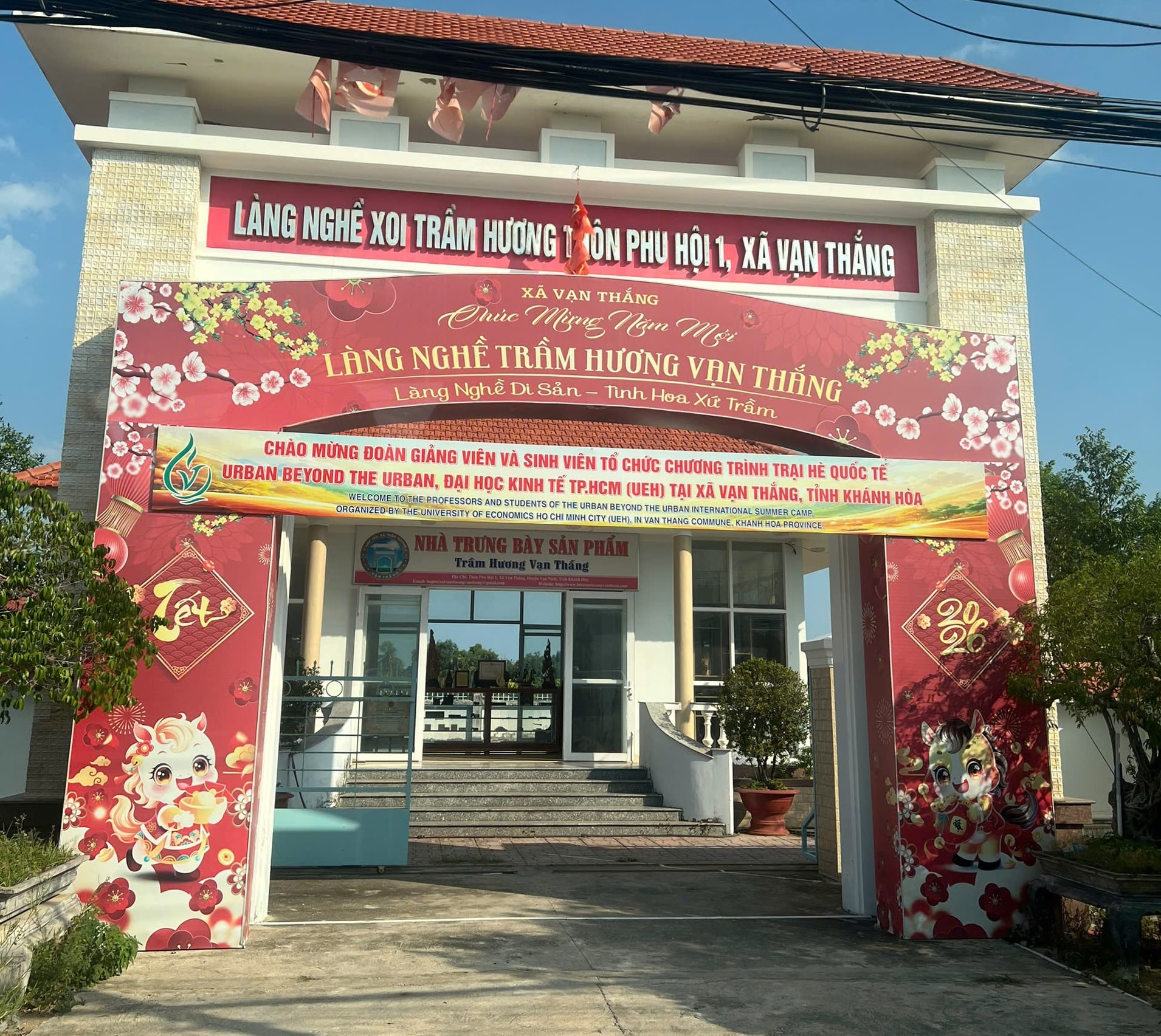
The entrance to the agarwood-carving craft village of Phu Hoi 1 hamlet, home to the Van Thang agarwood product showroom – the delegation’s first stop.
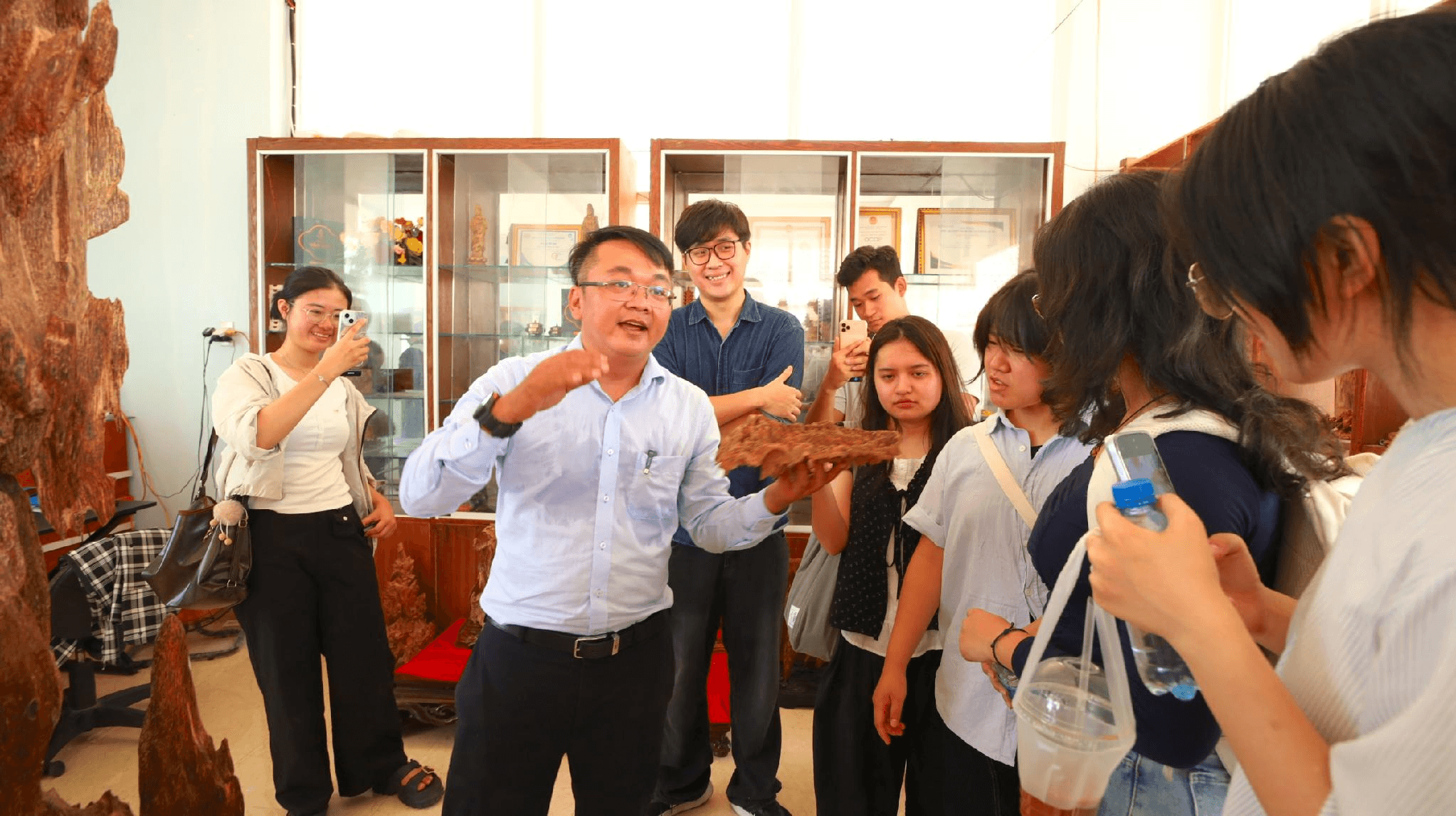
Students listen to a presentation on agarwood products and their value at the craft village showroom.

The delegation talks with craft-village representatives about their long attachment to the Aquilaria tree and the agarwood-carving trade.

Students try their hand at agarwood carving under the guidance of local artisans.

Students and local youth union members discuss and take notes during the field survey on the afternoon of 21 July.
Each household was recorded as a profile on the digital map, covering the head of the household, family characteristics, flagship products, years spent in the trade, and their hopes and expectations for the community’s development. Students also observed artisans at work through the stages of crafting agarwood from the Aquilaria tree. This is the "empathise" stage of design thinking put into practice, helping the groups understand residents’ lives, needs and difficulties before proposing solutions. The information gathered will form an important basis for identifying problems and building suitable initiatives in the days ahead.
To close the first day, on the evening of 21 July the Van Thang Commune People’s Committee hosted a welcome dinner featuring local specialities, followed by a lively and warm campfire programme. Around the fire, students, international lecturers and local residents talked, shared food and performed together. The easy atmosphere of that first night quickly dissolved any distance, laying the groundwork for the spirit of "building together" that will carry through the working days ahead.

The campfire programme welcoming the students and lecturers of the UBU 2026 programme.
Article and Photos: Institute of Smart City and Management (ISCM)