
LISTENING TO THE URBAN BEAT: EXPERT PERSPECTIVES ON GREEN PUBLIC SPACES IN HO CHI MINH CITY


How can we bridge the gap between technical planning maps and the lived experiences of urban residents? Within the framework of sustainable urban development research, the Institute of Smart Cities and Management (ISCM) under the UEH College of Technology and Design (UEH-CTD) officially released the Technical Report: "Analysis of Survey Data on User’s Perceptions of Public Spaces in Ho Chi Minh City".
The report was conducted by the ISCM Public Space Living Lab (PSLL), under the direction of Dr. Trinh Tu Anh (Director of ISCM), Daniela Hurtarte (Project Director), Project Advisor Tran Khac Minh, and the ISCM research team. The study offers key empirical findings, shedding light on how the community interacts with parks and recreational spaces across Ho Chi Minh City.
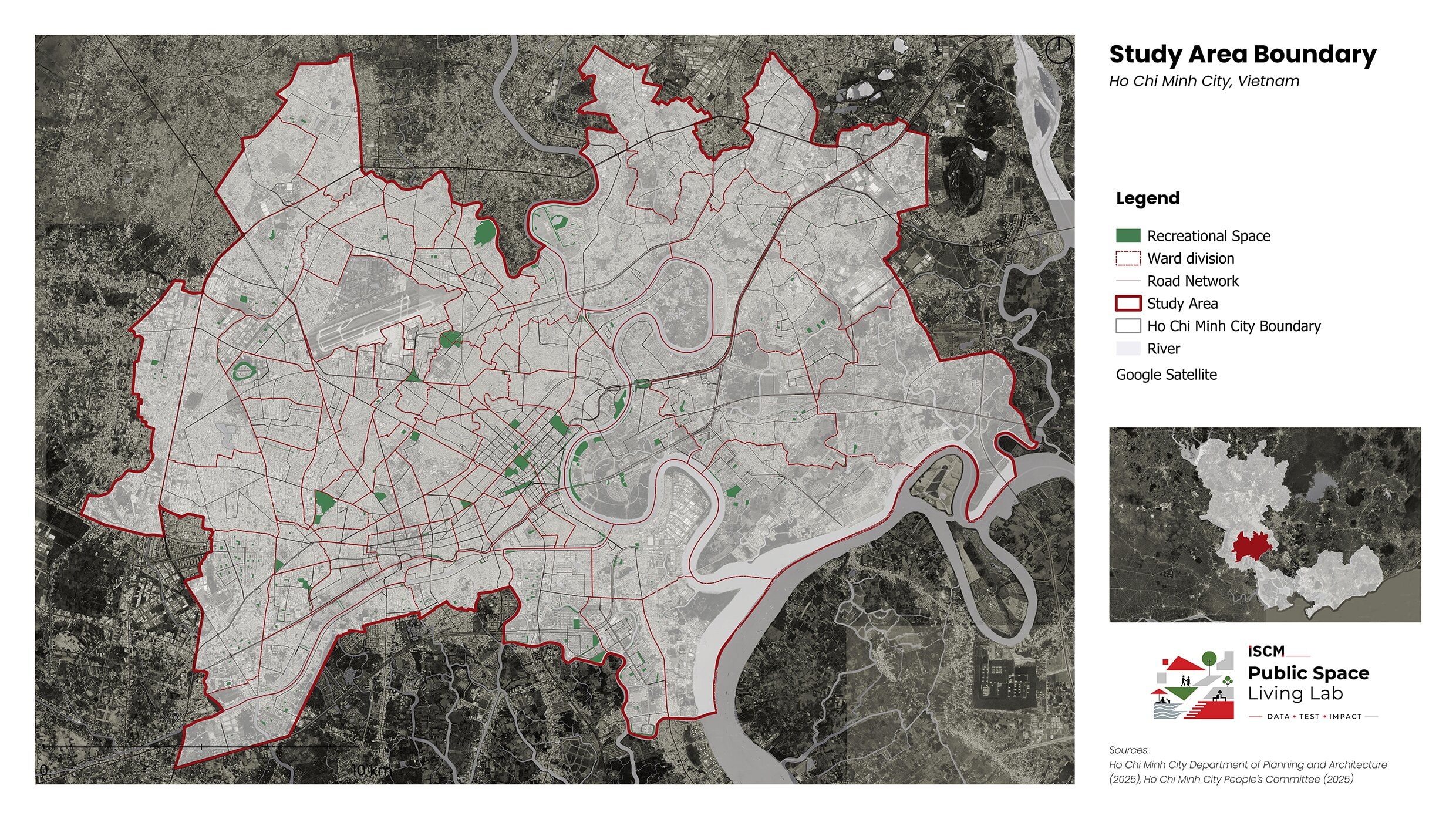
Overview map of the public and recreational space network in Ho Chi Minh City. Source: ISCM PSLL (2026).
Key Highlights & Expert Insights
This work responds to a growing urban challenge. Ho Chi Minh City currently provides approximately 0.6 m² of public space per resident, while the city's target is to increase this to 1 m² per person. For comparison, the World Health Organization (WHO) recommends approximately 9 m² of green public space per person. Addressing this gap requires more than creating new parks. It requires understanding whether existing public spaces are accessible, green, recreational, and responsive to the needs of the communities they serve.
The research is based on processing and analyzing 637 completed survey forms from 213 participants, directly evaluating 171 distinct public spaces across the city. The data focuses on five core aspects: accessibility, green elements, amenities and equipment, spatial scale, and urban living habits.
Accessibility and Transport Infrastructure.
Surveys reveal that accessibility to public spaces in Ho Chi Minh City is high at the residential area, ward, and inter-ward levels, ranging from 91.4% to 92.3%. However, for city-scale parks and spaces, accessibility drops to 71.0%. The overall satisfaction rate regarding open and free access reached 88.4%, while satisfaction among key focus groups such as children, the elderly, and people with disabilities reached 94.2%.
Regarding modes of transport, personal two-wheeled vehicles remain the most popular choice at 58.1%, followed by walking or cycling at 30.1%. Meanwhile, public transit and private cars account for modest shares of 7.8% and 3.9%, respectively. Limited parking availability restricts the convenience rate for car users to 64.0%, significantly lower than the 85.6% to 92.7% recorded for motorbikes, walking, or cycling.
Quality of Green Spaces and Amenities.
Regarding the quality of green spaces, positive ratings at the neighborhood and ward levels range from 79.5% to 81.8%. This proportion increases significantly at the inter-ward and city levels, reaching 90.7% to 90.8%, reflecting that larger-scale spaces are typically better planned and designed.
Conversely, the level of amenities tends to decrease as spatial scale increases, dropping from 39.5% at the neighborhood level to 13.7% at the city level. Specifically for public toilets, availability is concentrated primarily in larger spaces, reaching 25.1% at the city level compared to 12.3% at the neighborhood level. Notably, the report also highlights an anomaly with a high user density at the inter-ward level (54.4%) compared to the city level (39.0%).
Social Dynamics and Variations Across Spatial Scales.
Empirical data shows that public spaces in Ho Chi Minh City currently cater primarily to daily personal needs, such as exercising and walking (71.6%) or resting and relaxing (62.6%). Nevertheless, community bonding remains common, with 61.7% of residents visiting in groups. Regarding community events, 49.5% of respondents noted participating in or seeing events, 11.6% reported none, and 38.9% were unaware.
Spatial scale plays a decisive role in activity diversity and user behavior. As scale expands from the neighborhood level to the city level, the proportion of spaces supporting diverse activities increases from 18.4% to 43.7%; social interaction activities increase from 11.7% to 27.2%; group visits increase from 51.4% to 79.8%; and community event capacity rises from 43.8% to 65.5%.
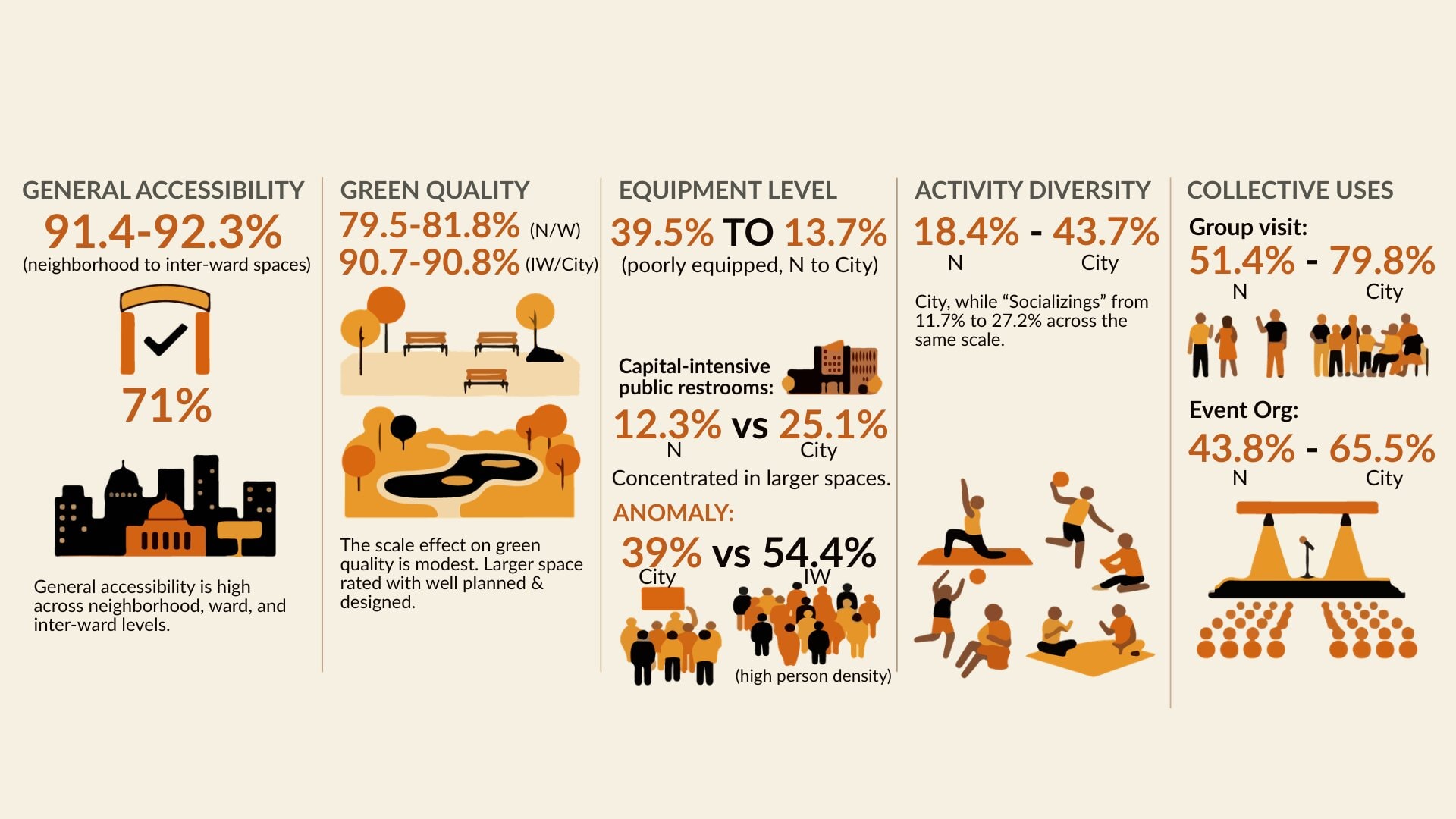
Diagram analyzing the correlation between spatial scale, activity diversity, and collective usage trends. Source: ISCM PSLL (2026).
According to Project Advisor Tran Khac Minh, residents' willingness to travel further to larger, well-equipped parks reflects a reality: high-quality experiences and green coverage possess an appeal that overcomes geographical distance barriers.
Completing this in-depth study based on 637 real responses from residents marks an important step for the Institute of Smart Cities and Management (ISCM) in promoting community data-driven planning. Assessing the project's significance, Daniela Hurtarte, Project Director, shared that integrating residents' experiences and feedback into technical mapping helps managers identify existing infrastructure gaps. This serves as a practical foundation for ISCM to propose design scenarios and management policies tailored to the actual living needs of Ho Chi Minh City residents.
The success of this study not only provides practical reference value for managing and developing urban green spaces, but also makes a meaningful contribution to the academic event series commemorating the 50th Anniversary of UEH. Furthermore, the compiled data and findings will serve as a valuable practical resource, directly supporting teaching and enhancing training quality for Undergraduate and Master's programs in Smart City Management and Sustainable Design at ISCM.
References & Links:
Detailed Technical Report: Download and read the full Report here
Cổng thông tin dự án: Explore the PSLL Portal
News and photos by: Public Space Living Lab (PSLL) – Institute of Smart Cities and Management (ISCM)