
RESILIENT BY NATURE: RETHINKING URBAN RESILIENCE THROUGH LANDSCAPE-LED PLANNING AND COLLABORATION


On November 19, 2026, the Institute of Smart City and Management (ISCM), under the UEH College of Technology and Design, in collaboration with SWA Group, organized the international seminar “Resilient by Nature” at Campus A, University of Economics Ho Chi Minh City (UEH).
The seminar brought together urban planners, landscape architects, researchers, and local government representatives to explore innovative approaches to nature-responsive urban infrastructure, with a shared vision of creating sustainable and resilient living environments amid increasing urbanization and climate-related challenges.
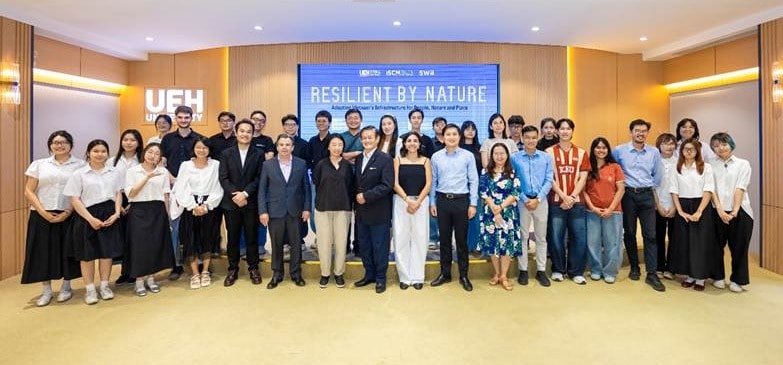
Overview of the “Resilient by Nature” seminar at UEH on November 19, 2026
FROM INFRASTRUCTURE CHALLENGES TO SUSTAINABLE URBAN PLANNING
In their opening remarks, Assoc. Prof. Dr. Trịnh Tú Anh, representing ISCM, and René Bihan, representing SWA Group, emphasized the importance of bridging academic research and international professional experience to identify urban development solutions that respond to natural conditions and local contexts.
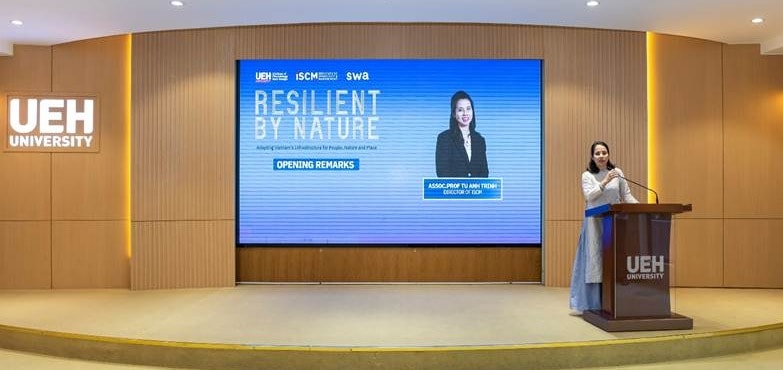
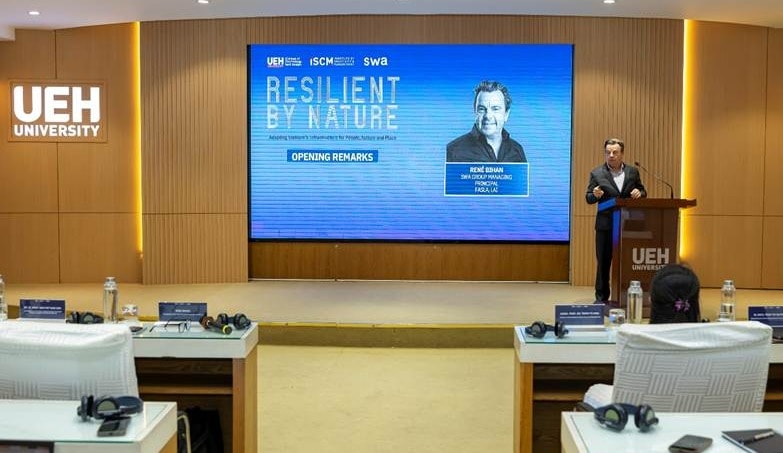
Opening remarks by Assoc. Prof. Dr. Trịnh Tú Anh and René Bihan
The first presentation, delivered by Dr. Ngô Viết Nam Sơn, addressed critical challenges related to urban planning and the financial feasibility of Ho Chi Minh City's metro system. The presentation highlighted that developing metro networks and Transit-Oriented Development (TOD) areas requires substantial investment, alongside comprehensive assessments of economic performance, connectivity, environmental impacts, and long-term public benefits.
Beyond transportation infrastructure, the speaker emphasized the importance of preserving urban heritage and local identity. From the historic fabric of Saigon–Cho Lon to emerging modern districts, Ho Chi Minh City needs an integrated planning strategy that balances economic growth, quality of life, and cultural preservation. Public–Private Partnerships (PPP) and multi-stakeholder governance were identified as potential mechanisms for mobilizing resources and balancing diverse interests.
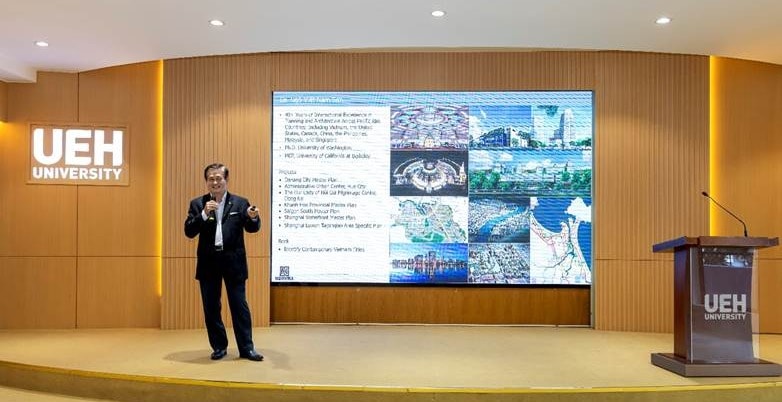
Dr. Ngô Viết Nam Sơn discussing metro planning, TOD, and Ho Chi Minh City's long-term development strategy
FROM SPATIAL DATA TO COMMUNITY-CENTERED URBAN EXPERIMENTATION
Continuing the seminar, Daniela Hurtarte (ISCM) presented research findings from the Public Space Atlas project, which developed a spatial database and assessed 486 public spaces across Ho Chi Minh City. In-depth studies in Bình Thạnh, Thạnh Mỹ Tây, and Bình Quới further examined spatial distribution, accessibility, and the quality of urban green spaces.
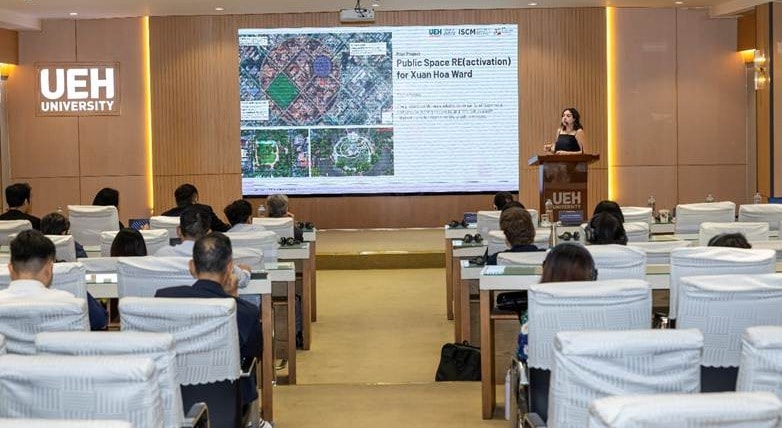
Daniela Hurtarte presenting ISCM's Public Space Atlas research findings
Importantly, the research extends beyond data collection and spatial analysis toward practical implementation through the Living Lab approach, in which design interventions are tested in real-world environments with community participation.
One example is Phan Đình Phùng Park, where 1.44 hectares of underutilized urban land have been temporarily transformed into public space since January 2026. Through research and experimentation in the Turtle Lake–Phan Đình Phùng Park area, ISCM has facilitated collaboration among local authorities, researchers, and residents to develop, test, and evaluate improvements to the living environment.
These initiatives demonstrate ISCM's commitment to translating research evidence into practical, people-centered spatial interventions with the potential for wider application.
INTERNATIONAL PERSPECTIVES ON BLUE-GREEN INFRASTRUCTURE AND RESILIENT URBAN DESIGN
Representatives of SWA Group, an international landscape architecture, planning, and urban design firm, shared professional insights from projects in the United States, South Korea, and China. The presentation explored three interconnected approaches: Blue-Green Infrastructure, Transit-Oriented Development, and Placemaking & Agricultural Heritage.
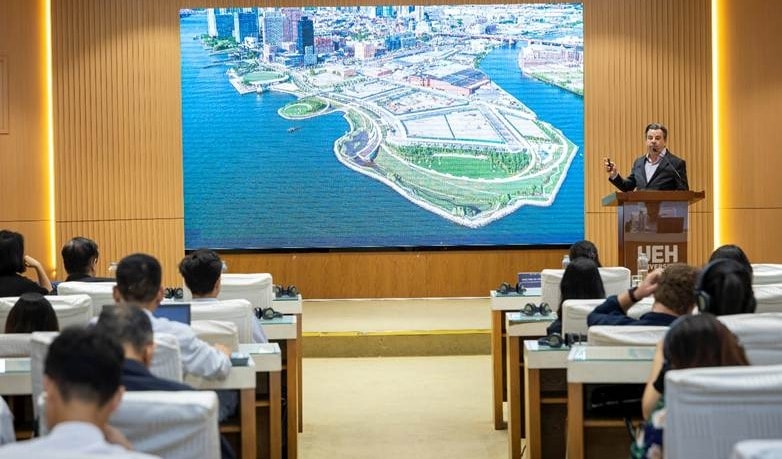
SWA Group representatives presenting international approaches to landscape design and resilient urban infrastructure
Buffalo Bayou Park in Houston and Hunter's Point South Park in New York illustrated how ecological restoration, stormwater management, flood resilience, and public recreation can be integrated into urban landscapes. Meanwhile, public realm projects associated with transportation networks in Seoul demonstrated the importance of pedestrian connectivity and user experience in strengthening the performance of TOD districts.
Another example, Nanhu New County Village Lake Park in China, introduced an approach that combines waterway restoration, agricultural landscapes, ecological spaces, and community activities.
Across these projects, SWA Group highlighted the potential of rivers, canals, and natural landscapes to serve not merely as environmental assets requiring protection, but as fundamental components of urban infrastructure.
This landscape-led planning approach offers valuable lessons for cities such as Ho Chi Minh City, where ecological characteristics and local identity are essential to sustainable development.
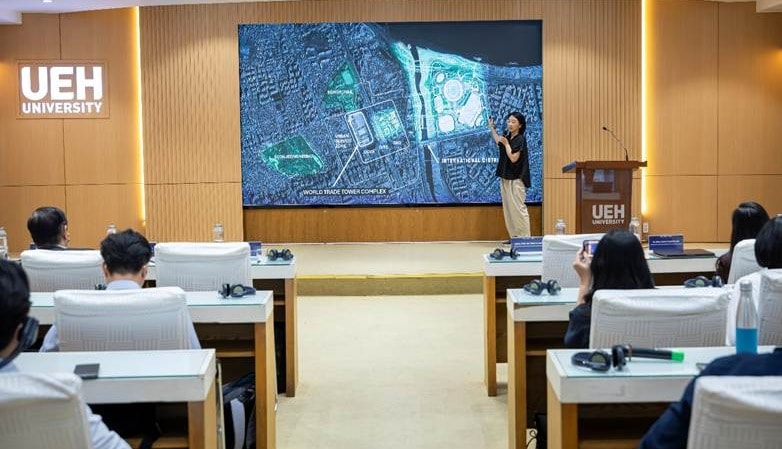
Selected SWA Group projects demonstrating blue-green infrastructure, TOD, and landscape restoration.
MULTI-STAKEHOLDER DIALOGUE: TRANSLATING RESILIENT DESIGN INTO PRACTICE
The panel discussion was moderated by Dr. Phạm Nguyễn Hoài (ISCM–UEH), featuring René Bihan and Ji-Hyun Yoo (SWA Group), Dr. Ngô Viết Nam Sơn (NgoViet Architects & Planners), and Daniela Hurtarte (ISCM–UEH).
The discussion focused on the practical application of Nature-based Solutions (NBS) in infrastructure planning, public space development, and urban governance in Vietnam.
A central theme was the need to move beyond conventional infrastructure-driven development toward creating urban environments that support communities, strengthen ecosystems, and respond to environmental conditions.
Everyday spaces, including sidewalks, alleyways, neighborhood parks, and temporarily vacant sites, were recognized as important opportunities for enhancing urban livability.
The panelists also emphasized collaboration among local governments, businesses, researchers, and communities as a key condition for implementing green infrastructure. Demonstrating measurable economic, social, and environmental benefits was identified as essential for translating design proposals into feasible policies and development projects.
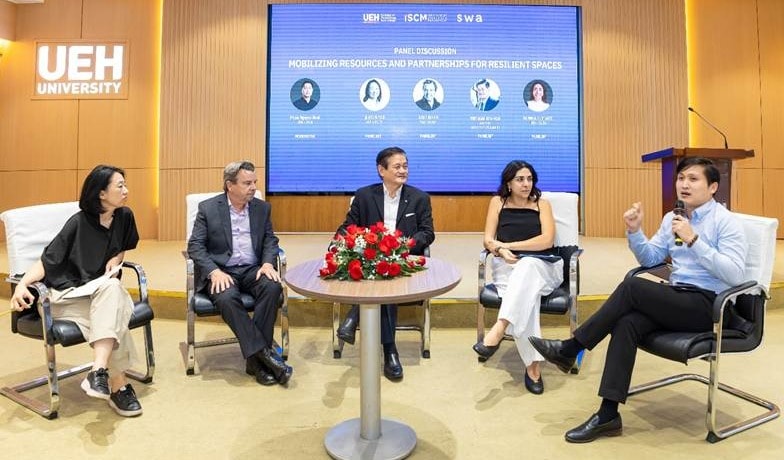
Panel discussion bringing together experts from ISCM and SWA Group
CONNECTING INTERNATIONAL KNOWLEDGE WITH LOCAL RESEARCH AND ACTION
The “Resilient by Nature” seminar provided a platform for dialogue between academic research and professional practice, while highlighting several priorities for sustainable urban development: landscape-led planning, integration of blue-green and conventional infrastructure, more effective TOD strategies, and participatory urban governance.
For ISCM, the seminar offered an opportunity to share its research and experimental initiatives with international partners and professional communities. Insights from SWA Group and participating experts will contribute to advancing ISCM's applied research, Living Lab initiatives, and collaboration with local governments.
The seminar also supported UEH's broader development vision as a multidisciplinary university connecting academia, industry, government, communities, and nature, in alignment with its University City and Innovation Hub orientations.
By connecting international expertise with local challenges, ISCM continues to strengthen its commitment to collaborative research, innovation, and the creation of sustainable living environments for future generations.