
UEH PROPOSES A “4+1” MODEL FOR HO CHI MINH CITY’S INTERNATIONAL LOGISTICS SERVICES HUB


On the afternoon of 25 November 2026, the Ho Chi Minh City Department of Industry and Trade held a roundtable titled “Developing Ho Chi Minh City into an International Logistics Services Hub” . The event sought input from experts, researchers, educational institutions, industry associations, and businesses on the proposed development model, current bottlenecks, and priorities for the city. Representing the UEH research team, Associate Professor Trịnh Tú Anh, Director of the Institute of Smart City and Management (ISCM), delivered a presentation titled “Shaping Ho Chi Minh City’s International Logistics Services Hub: Concept, Components, and Development Criteria.”
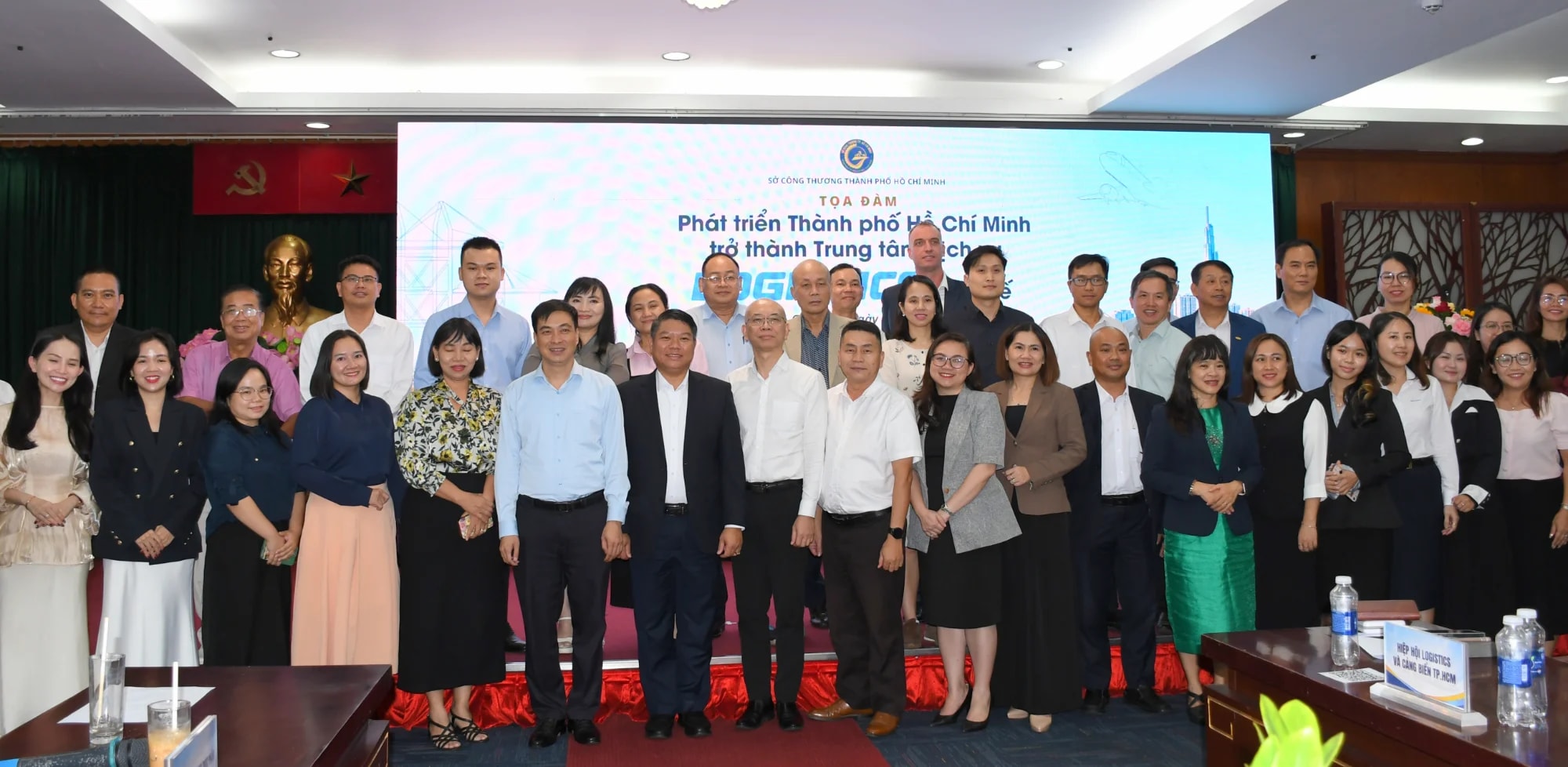
Figure: Group photo of all delegates in the conference
From a freight gateway to a supply chain coordination hub
How can Ho Chi Minh City build on its seaports, infrastructure, and freight volumes to expand its capacity to provide international logistics services? The team proposed a network connecting seaports, industrial parks, and urban distribution facilities. The network would also integrate reverse logistics to support repair, reuse, and recycling. The proposed “4+1” model comprises four functional layers covering physical infrastructure, the institutional framework for free trade zones, value-added services, and digital infrastructure. Its core would support cross-sector coordination, workforce development, research, and regular performance measurement. The team proposed pairing investment in inland waterway and rail connections to seaports with arrangements for data sharing among port operators, customs authorities, shipping lines, and businesses. Together, these measures would support services such as cold-chain logistics and cross-border e-commerce order fulfillment.
To track progress, the team proposed five groups of criteria covering scale and connectivity, value-added services, efficiency and institutional arrangements, green development and resilience, and workforce and knowledge. Illustrative indicators include the share of international transshipment cargo, terminal dwell time and customs clearance time, the share of freight carried by inland waterways and rail, emissions per twenty-foot equivalent unit (TEU), and the proportion of workers who have completed vocational training or earned a vocational certification.
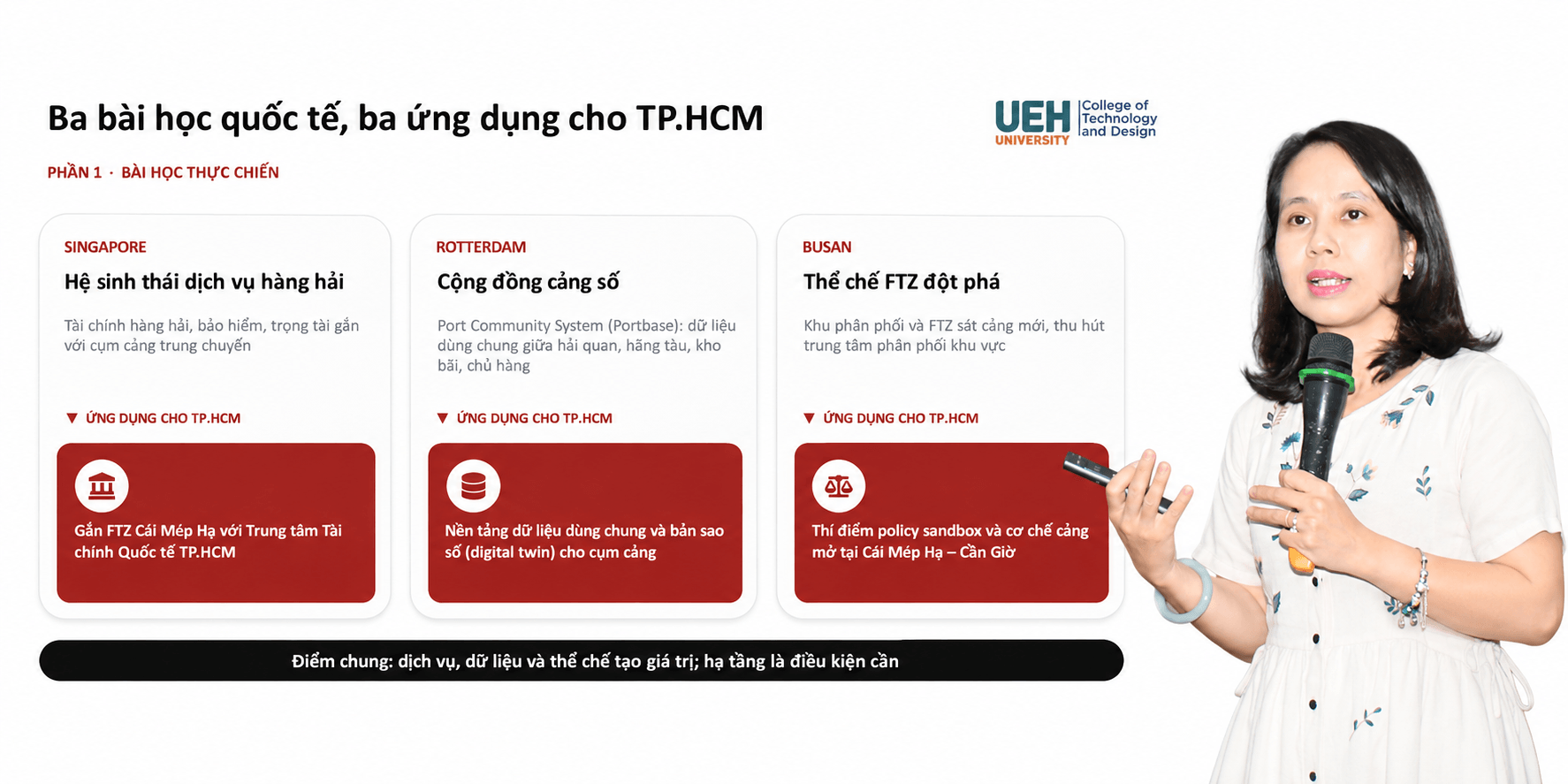
Figure: Assoc.Prof. Tu Anh Trinh delivers a presentation in the conference
Addressing bottlenecks and testing solutions
The presentation identified five bottlenecks, including imbalanced cargo flows across terminals, reliance on road freight, congestion at inner-city logistics hubs, gaps in infrastructure connectivity, and limited coordination and data sharing. The team proposed establishing a cross-sector task force and developing a shared data platform linked to a digital twin of the Cái Mép–Cần Giờ–Cát Lái port cluster.
Associate Professor Trịnh Tú Anh also joined a panel titled “From International Experience to a Model for Ho Chi Minh City: What Will It Take to Become an International Logistics Services Hub?” Panelists discussed how the city could apply lessons from abroad, which actions it should prioritize, and how public agencies, educational institutions, industry associations, and businesses could contribute.
A Living Lab would allow stakeholders to design and evaluate solutions together under real operating conditions, for example by piloting small-scale freight consolidation points or measuring emissions from last-mile deliveries. A sandbox would provide a controlled setting for testing new arrangements and procedures, such as integrating customs processes across ports or testing digital operations for bonded warehouses. The results could help the city refine the proposals and assess whether wider implementation is feasible. The 4P (Public - Private - People, - University Partnership) could bring together public agencies, businesses, local communities, and universities and research institutes to run and evaluate the pilots. Public agencies would coordinate the pilots and set the conditions for testing. Businesses would provide operational data and implement solutions. Residents and local businesses in pilot areas would give feedback on traffic, noise, and daily life. Universities and research institutes would help design the pilots, simulate operating scenarios, and evaluate the results.
UEH reaffirmed its commitment to working with the Department of Industry and Trade and other stakeholders to design and evaluate pilots, develop databases and digital maps, simulate operating scenarios, train the logistics workforce, and develop logistics performance indicators for Ho Chi Minh City.